Thursday, January 5, 2012

Clinton and National Civil Rights Museums-You Can Kill the Dreamer but You Can't Kill the Dream

Before we head to Nashville, a couple of things were left out of the last post that described our time in Memphis- our side trip to Little Rock, Arkansas, and the half day we spent in the National Civil Rights Museum in Memphis right before we drove back to Nashville. We thought it made sense to talk about those two visits together in one post; President Clinton was sometimes referred to as the nation's first "Black" president, and he did much to encourage and support civil rights..  Additionally, Little Rock was the scene of one of the most important battles in the fight for civil rights- the integration of Little Rock Central High School in 1957.

The drive from downtown Memphis to Little Rock is only a couple of hours, so we left early Friday morning and headed to Little Rock.  We immediately crossed the Mississippi, since the Mississippi borders Tennessee and Arkansas, so almost all of our drive was through Arkansas.  It was a fairly eye opening drive, although we don't have any pictures; the area seemed impoverished, and under water, both literally (there has been a lot of flooding there) and figuratively.  It really didn't improve until we were on the outskirts of Little Rock, the state capital.

The Clinton Museum and Library is part of the 17 acre William J. Clinton Presidential Center and Park. In addition to the Museum and Library, the offices of the Clinton Foundation, and the University of Arkansas Clinton School of Public Service. The design of the main building cantilevers over the Arkansas River, symbolizing President Clinton's campaign promise to "build a bridge to the 21st Century.

The very top floor of the building is a 2,000 sq. foot apartment for Clinton; there is a helioport on the roof. 

The physical plant is huge; it is the largest of the presidential libraries, the largest archive, and the most expensive. 


There are donors' names on the bricks; over 112,000 people donated to the library (including a donation of somewhere between $500,000 and $1,000,000 made by the wife of Mark Rich, who was pardoned by Clinton on his last day in office (but that wasn't mentioned in the Library).


The Museum's "feel and tone" is very different than that of the other presidential libraries we have visited on our trip.  Most of the others spent a lot of focus on the subject's life before he became president; lots of artifacts and anecdotes about growing up and their lives in politics leading up to the presidency; this museum contained almost none of that.  Most of the others had rooms or areas dealing with specific major issues in the subject's presidency; the Clinton Museum is much more detailed.  The center of the main floor is a "timeline" with separate displays for each of the 8 years of the Clinton Presidency: 


A typical panel- besides the timeline and photos the binders towards the bottom contain a facsimile of his  daily appointment calendar for each day of the year. 

View from one end of the room; there are panels for each of the eight years. The bookshelves hold boxes of presidential records, but only about 2 or 3 percent; the balance are light protected by being underground. Between the shelves are the alcoves discussed below. 


The eight timeline panels center the floor, and along the sides are 14 alcoves, each of which highlights a particular subject during Clinton's presidency.  Topics include things like "Protecting the Environment"; alcoves on the Middle East peace efforts and the Oaklahoma bombing; and one on the work of the first lady. Here is the one entitled "Putting People First": 


The Alcoves are jammed with information, archival documents, short repeating video clips, and artifacts.  The one that seemed to be of great interest was one called "The Politics of Power" , the theme of which seems to be the persecution of the President by his adversaries.  The alcove includes information about Whitewater, the impeachment, and the special prosecutor.  Newt Gingrich is singled out for criticism for his role in the impeachment; Monica Lewinski is barely mentioned; in fact I can't recall that her actual name appeared anywhere except perhaps in some of the video clips. The clear impression that the alcove is meant to give is that all of the investigations, including the impeachment, were the result of political power struggles once the Republicans took over the House. 
There is a second floor with additional displays, including gifts given to the Clintons during their years in office; personal correspondence; the giving of an official state dinner; and the President's saxophones:


There is also a full size mockup of the Cabinet Room


And, of course, a mockup of the Oval Office during President Clinton's term.  This is the only mockup, however, that is a full size mockup instead of the usual half or three quarter size mockups; it really gave us a good idea of the size and majesty of the office itself.


 The President used the desk carved from timber from the ship "Resolute"; it has been used by almost all Presidents since Grover Cleveland
That's a moon rock in the display case on the coffee table.

The museum's basement has a very nice restaurant, called "42" (we can't figure out why), that actually has multiple heart smart choices, most likely because of the President's bypass operation. The restaurant is good enough so that people working in Little Rock come there for lunch.

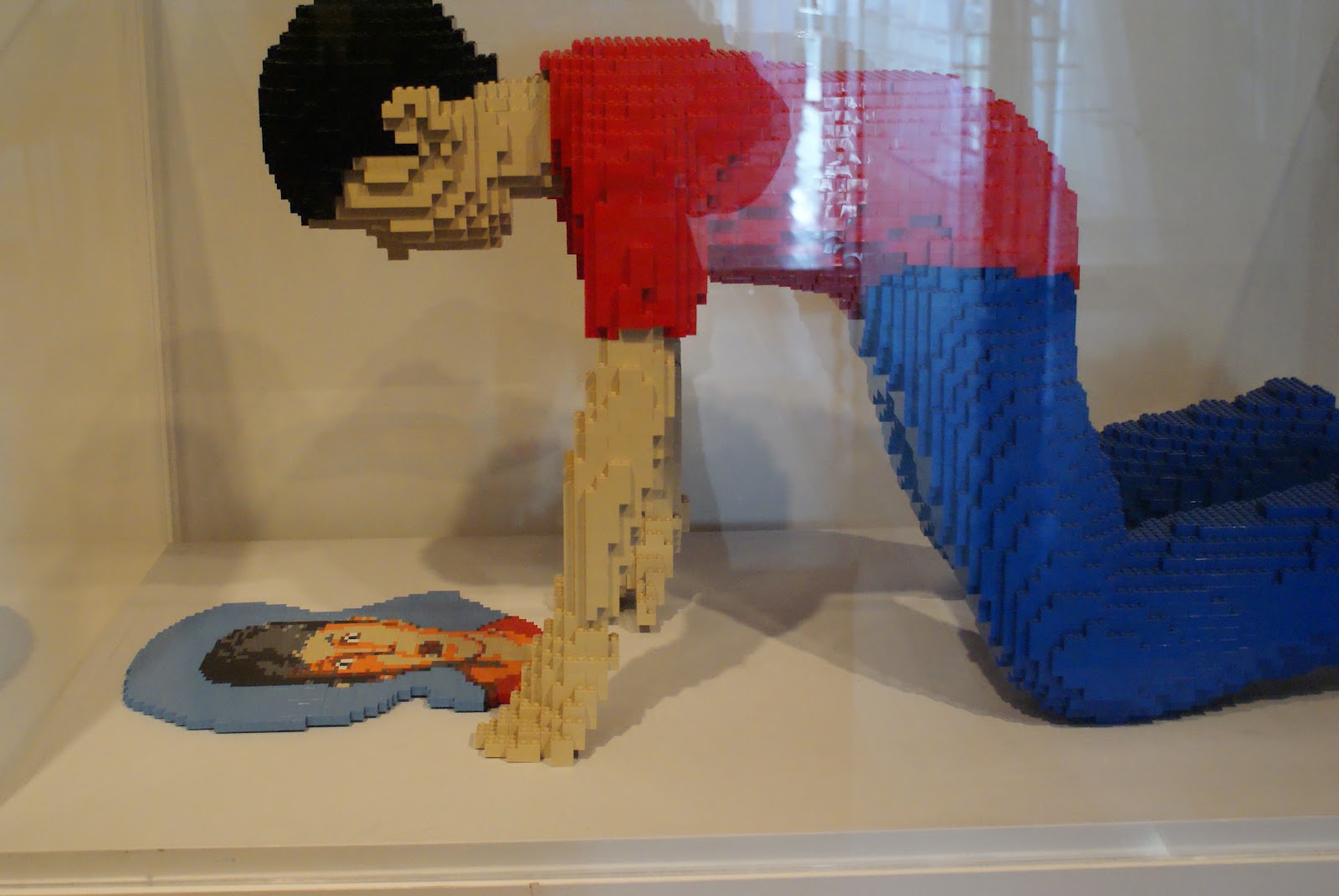
A portion of the display space was used for display of a lego sculpture artist's work. We aren't sure what it has to do with the President, but the work was really cool:



So that was our visit to the Museum; there were two real differences, we felt, between this one and the others we visited: first, in the others, there is a sense that history has defined the subject's legacy and the museum is displaying that legacy. In this museum, the overwhelming feeling we had was that President Clinton is using the museum to define his legacy as he wants to see it defined.  We have read that he advised the architects and the exhibit designers that he wanted "transparency"; it doesn't seem that transparent but rather as if we were in a room with his people "spinning" the way events should be seen. We certainly can't imagine this museum having alternative points of view, as was the case in Truman's museum with topics like the Atomic Bomb, or having a display that put the president even questionably in a bad light, as was the case in the FDR Museum as to his trying to save the Jews of Europe.

And second, at least Alan was overcome with a sense of sadness as he walked through the museum; when you spend four or five hours transported back into time, in this case the last eight years of the 20th century, but it is a time you experienced yourself, and it is a time right before 9/11, right before the wars in Iraq and Afghanistan, during a time when there were budget surpluses, low unemployment, and great strides being made in so many areas of life, and you can almost touch that era when you see the smiling Clinton and Gore (and their wives) aboard their campaign bus, with so much hope in front of them, and then you are suddenly jerked back to today, it's hard not to be sad. But now that era is history, and so here is the obligatory "Alan in front of presidential museum" shot:


And on that happy note, we leave Arkansas and go back to Memphis to spend some time in the Civil Rights Museum and to contemplate Dr. Martin Luther King.


Faith is taking the first step, even when you don't see the whole staircase.


In the end, we will remember not the words of our enemies, but the silence of our friends.


It may be true that the law cannot make a man love me, but it can stop him from lynching me, and I think that's pretty important.

I believe that unarmed truth and unconditional love will have the final word in reality. 
That is why right, temporarily defeated, is stronger than evil triumphant.

Dr. Martin Luther King 

Dr. King was assassinated while standing on the balcony of the Lorraine Motel, on the edge of downtown Memphis. He was there to support striking sanitation workers, to better their economic struggle through the use of non-violence. The owner of the Lorraine Motel preserved Dr. King's room (306) and the rooms next to it  and continued to operate the property until the 80s (as a very sad aside, the motel was named after the owner's wife, who had a stroke when she heard about the assassination and died 5 days later). Once it closed, a private foundation acquired it, built an adiittional  building around it, and opened the National Civil Rights Museum, a stunning, educational, and very moving museum. 


The wreath is in front of Room 306  The cars parked there are duplicates of the cars that were actually parked there at the time of the assassination. 


No photos are allowed in the museum, but it starts with a very moving film called "The Witness" in which people who were with Dr. King during that last fateful hour recall what they saw and how they felt.  Visitors then travel from area to area, each of which have a lot of information about a specific part of the civil rights struggle, starting in the 17th century and moving until the 1960s.  There is a replica of the Rosa Parks bus; of the sandwich counters where sitdowns were held, and of other symbols of the movement.  An area is dedicated to the Freedom Riders, another to the  Brown v Board of Education  decision, and another to the struggles following Brown. There are areas graphically showing lynchings, and reconstruction, and slavery.  


While we weren't allowed to take pictures, we took some from the net to give you an idea of what the exhibits were like: 


 At the very end of the tour, you are led into a hallway that takes you right next to Dr. King's room which has a plexiglass wall. You can look out onto the balcony and see the flophouse across the street where James Earl Ray fired the single, fatal shot. 


Once you leave the Lorraine, you can go across the street to that flophouse (now also owned by the Museum) and see where James Earl Ray fired the shot. The building has been converted into a museum exploring the assassination and includes evidence submitted at trial, including the rifle, and lots of information about the assassination and the aftermath. There is also a room with a memorial wall memorializing the victims of political assassinations from all walks of life, including people as diverse as Steve Bilko and Harvey Milk. 


The Museum was truly memorable; our only regret was that we didn't have more time to spend there, although we did spend about 4 hours there.  


But we had to leave to drive back to Nashville; we had tickets to the Opry that night! 


Next- our final destination on the 6 month tour- Nashville, Tennesee! 

Sunday, January 1, 2012

Memphis and Three Kings


For our last long trip in our great adventure, we went to Nashville, Memphis and Little Rock.  We started and ended the trip in Nashville, which we will cover in another blog (spoiler alert- we both loved the Grand Ole Opry a lot more than we thought we would!) and spent the middle part of the trip in Memphis. Little Rock is only two hours outside of Memphis (Memphis borders both Arkansas and Mississippi) so we spent one day driving to and from and visiting the William Jefferson Clinton Presidential Library and Museum in Little Rock, which we will also talk about in another post.

Memphis is music. It's the cradle of rock and roll; the home of Sun Records, of Stax Records, of great blues musicians, including BB King (the first King), of Gibson Guitars (at least hollow bodies like BB King's Lucille), and of Graceland, the home of the second King- Elvis.

Memphis is history, both local and National. It's named after the ancient capital of Egypt, and indeed, has the great pyramid as a landmark in the City. Although a cabbie told us that the Memphis Pyramid is  infamous as the arena where Mike Tyson bit off his opponent's ear, our friend Wiki tells us that the cabbie is wrong- the ear biting incident was in Vegas. Tyson did fight in the Pyramid in 2002 after he was banned in Nevada and several other states, and after he was released from jail after being convicted of rape, but he lost his big Pyramid bout.  What a guy. We promise we won't mention Tyson again in this blog.

The arena has been vacant for years and appears to have been sold to Bass Pro for a retail store. 

Memphis' location on the Mississippi made it an ideal center of commerce for the cotton industry, and for the slave trade; in fact before the Civil War a quarter of the population of Memphis were slaves. During the Civil War, Memphis was briefly a Confederate stronghold, but was quickly captured by the Union and remained a Federal supply base throughout the War. Neither of us had seen the Mississippi before our Excellent Adventure; now we have seen it from Illinois, Missouri, Iowa, Louisiana, Tennessee, and Arkansas. We think our views of it from our hotel in Memphis were the best.

Views of the Mississippi from our Hotel


Memphis is deeply steeped in Southern Tradition and Hospitality. In fact the Peabody Hotel in downtown Memphis, one of the grand hotels of the South,  is a Southern landmark.


As our friend Wiki says:

The storied Peabody Hotel opened in 1923 and became a symbol of upper-class Southern elegance. In 1935, a Mississippi author wrote, "The Mississippi Delta begins in the lobby of the Peabody and ends on Catfish Row in Vicksburg. The Peabody is the Paris Ritz, the Cairo Shepheard's, the London Savoy of this section. If you stand near its fountain in the middle of the lobby, where ducks waddle and turtles drowse, ultimately you will see everybody who is anybody in the Delta.


Yes, you read that right, if you read it at all.  During the 30s, the general manager of the Peabody came back from a hunting trip after generously sampling the Tennessee whisky and decided it would be funny to put his live duck decoys in the fountain in the center of the hotel.  A bellman at the hotel, formerly an animal trainer with Ringling Brothers, said he could train the ducks to walk from the fountain to the lobby elevator and that would attract guests.  A tradition was born; the ducks come down from their penthouse at 11 each morning and return to their penthouse at 5 in the afternoon, led both ways by the hotel's "Duckmaster".  Well worth spending an hour in the lobby having a refreshment and watching the show. 


They spend the day swimming around the fountain 

The Duckmaster brings out the red steps and lays down the red carpet around 4:45. 

Elevator reserved for the ducks twice a day. 

Appointment of an Assistant Duckmaster for the day 

There they go 

Duckmasters prompting the ducks out of the fountain

The Ducks sleep in a quarter million dollar, air conditioned penthouse on the roof of the hotel. 


Memphis is also the home of a number of racial struggles, and the home of any number of great African-American musicians including W.C. Handy, the Father of the Blues, John Lee Hooker, Howlin' Wolf, Booker T. Jones, Otis Redding, and Memphis Slim. A local photographer, Ernest Withers, documented much of African-American life during the 40s, 50s and 60s, and there is a museum of his work right on Beale Street: 


(Copyright Ernest Withers; the museum is very moving but there is controversy surrounding the photographer; he apparently was an informer for the FBI while being an "insider" in the Civil Rights Movement. See http://www.commercialappeal.com/news/2010/sep/12/photographer-ernest-withers-fbi-informant/) 


 and Memphis is the place where Dr. Martin Luther King came to support sanitation workers and died while he stood on the balcony of a cheap motel. 


Much more on the Lorraine Motel, the National Civil Rights Museum, and Dr. King in our next blog
With such a rich history, there was a lot to see and do in Memphis, and we did a lot. We toured the Gibson Guitar Factory, where hollow body Gibsons like the SGs are made. There is very tight security on the tour and no photos are allowed, but we took a couple of pictures in the adjacent retail store and the outer lobby: 


We visited Sun Studios, the recording studio started by Sam Phillips in the early 50s; to make money Sam advertised that he would record anything, and so when a young truck driver wanted to cut a record for his mama, he came to Sam's studio. Sam wasn't there that day, but his secretary handled the recording, and remembered the young man a year later when Sam was looking for a vocalist for a song Sam had acquired. During a break in the recording, the singer fooled around with a version of Arthur Crudup's "That's All Right Mama" and Sam liked it enough to hawk it to a local Memphis DJ, who played it over and over, and more or less "broke" Elvis Presley. As an aside, that local Memphis DJ, Dewey Phillips (no relation to Sam) was the DJ on whom the Broadway play "Memphis" was loosely based (see how all of our trips relate to each other?). 


 The Sun Studio tour was full of history and it was awe inspiring to stand in the same room, basically preserved as was, as such great performers as Elvis, Johnny Cash, Carl Perkins, Jerry Lee Lewis, and Roy Orbison recorded in. 


this is where you wait for the tour to start; luckily there are refreshments, souvenirs, and tchatchkas for sale to while the time away 

original one track recorder used by Sam 

The recording studio itself is actually small and modest but just emanates the spirit of Rockabilly


Place where Elvis stood while singing "That's All Right".  Bob Dylan walked in unannounced right in the middle of a tour, knelt down and kissed the X and walked out without saying a word. The tour guide ran after him and said "Mr. Dylan, I'm a huge fan"; Dylan's only reply was "Well son, we all have our heros" and he walked away. 


This is the mike Elvis used; it's now been used by him, me, and probably half of the population in this country. A very close connection. 

Desk used by Sam's secretary.  Elvis would sweet talk her into getting him a gig. 
Now that we had seen where Elvis got his start, it was time to see where he lived as a big star; it was time to go to 


As was the case with the Grand Canyon, we went there with many preconceived notions; we were sure it would be over the top, cheesy, and the Nation's number one tourist trap.  And much as our preconceived notions were wrong at the Grand Canyon, they were wrong at Graceland (although we are not suggesting that Graceland could possibly be in the same category as the grandeur of the Grand Canyon).  We found Graceland to be well done; the home itself could barely be characterized as a mansion, although it is very large, and the decorations are clearly preserved as they were in the mid 1970s. Is it decorated in an over the top fashion? Not if you compare it to any yearbook from anyone who graduated high school in the mid 70s- those of us who lived it don't care to think about the fashion sense of those particular years, but Graceland is not out of line with that "style". But judge for yourselves: 


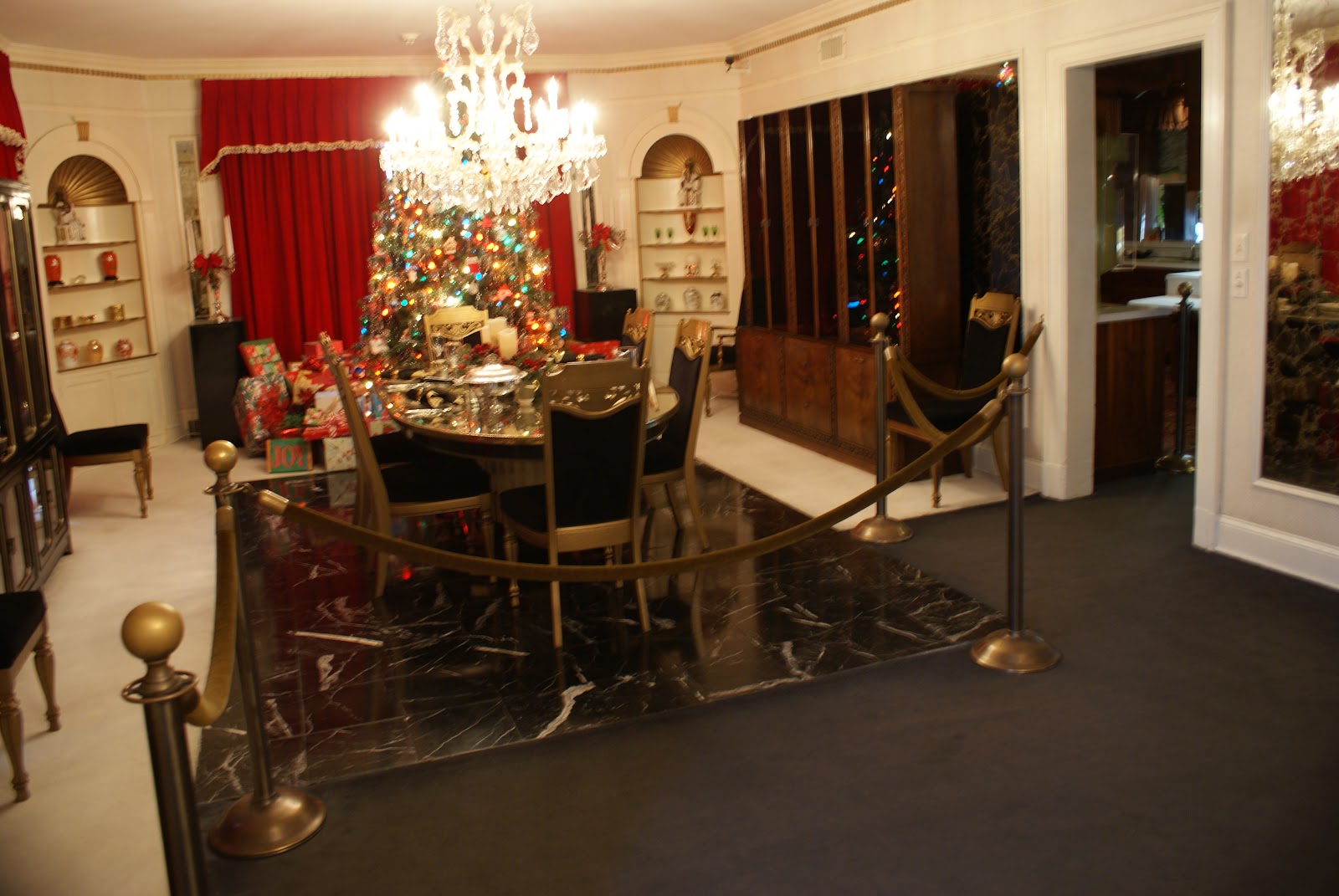
View to the left as you walk in- the dining room 

View to the right as you walk in- the living room/music room 

Table by living room- note his parents' picture. 

Stairway leading upstairs to the bedrooms- no admittance up there 

Father Vernon's Bedroom 


Kitchen 

View from Kitchen into Jungle Room 

Basement Television Room- the Tvs are playing shows from the early 70s

Stereo and part of his record collection 

Bar in the Television Room 


That left only one room left to see- the famous "Jungle Room."  We climbed back upstairs to the first floor, and there it was: 


We left the home, and walked around outside. 


Lisa Marie's Swingset 

Area for riding horses 

Back of the Mansion 

Swimming Pool with Meditation Garden in Back 

There are several other buildings on the property, including a building that he and his cronies used to use to race go carts, little tractors, and other "toys" around; it is now filled with his trophies, awards, and artifacts. 

Gold Records from Sun Studios Years 

Elvis Memorabilia 


Says it all 

We'd never seen real Grammy Awards before 

Black Leathers from his 68 Comeback TV Show 


They have also converted his Raquetball Court into a museum of sorts: 


Area outside of the court where his friends would goof around before and after games 

Thinking about the King 

Las Vegas Elvis 
The time had come to pay respects, so we headed to the Meditation Garden- an area designed by Elvis for quiet contemplation; it became the final resting place for his parents, grandmother, brother, and Elvis himself. 


Oh, Elvis!  But we weren't done yet!  Right across the street are two separate shopping/museum complexes for further thought, contemplation, and reflection (and the museums were included in the ticket price, so what the heck). 


The Car Museum: 


We loved the color 

Doesn't everyone have matching black and white Bentlys? 


The Fashion Museum: 


Elvis never wore jeans; he said he wore enough jeans when he was poor 


Part of his famous gun and badge collection 


 A couple of other museums that we ran through and didn't take any pictures (including one completely dedicated to the 68 Comback- really they were gift shops with a few cases of artifacts attached) 


 and, finally, 


The Lisa Marie- one of his two planes


Yep- gold plated bathroom fixtures 


Some of his clothes left in the plane closet 


yep- 24K seat belts 


Well, what can you say? He is beloved the world over; people come from every corner every day there (although we must say that if you go during the workweek in December, as we did, it was not very crowded; the crowd control and parking lots were obviously set up for thousands and thousands, and we don't think there were 100 there while we were there).  


So we finished our visit to Graceland; it was 3:30; we had had a very busy day, but there was still time for one more iconic visit- off we went to Stax Records.  Stax was actually demolished after it closed by the Church that bought the property; a decade ago it was completely rebuilt to replicate the original Stax, which was a converted movie theater. Part was used as a record store and part as the recording studio. 


The theater that was converted into the record store/studio 


The school that has become a part of the Stax complex; a high school for the performing arts. The people at Stax have made the school, the studio,  and the surrounding campus a living memorial to Stax and sponsor the school and many community events and programs 
Motown bills itself as "Hitsville USA"; Stax bills itself as "Soulsville USA", in direct counterpoint to Motown. There is a Wilson Pickett hit of the same name [actually 6345-789 (Soulsville, U.S.A.)].  What a rich history. Stax was home to Booker T (and his band mates  Steve Cropper and Donald "Duck" Dunn, all were also part of the Stax house band; kind of a southern "Funk Brothers"); Wilson Pickett,  Albert King, Sam and Dave, Isaac Hayes, and Otis Redding, whose untimely death would eventually be one of the causes of the decline of Stax. 


The Stax Museum is much more than the history of Stax; it is 17,000 square feet of exhibit space with over 2,000 artifacts and exhibits (including a real 100 year old Mississippi Delta church and the Soul Train Dance Floor- the Soul Train videos were a special treat both for the dancing and the outfits); and is beautifully done. It celebrates all soul music, not just the music put out by Stax. 


Ike and Tina Costumes 

Replica of the recording studio


Booker T's Hammond Organ 


The studio area; because it was part of a theater, it is a huge space compared to Sun. 

Steve Cropper's guitar- a special treat for Alan who is a big Steve Cropper fan  (if you don't know him, think about the Blues Brothers films- he's the bearded sunglassed guitar player in the band- both Sam and Dave and John Belushi yell out "Play it Steve!) during their respective versions of  "Soul Man". 

Part of the display area 

This is an area that has all of the singles released by Stax; this is a small part of the wall 

Isaac Haye's Ride; and they say Elvis was over the top 


several displays are dedicated to Motown including this showcase 
So after a day that started at Sun, wandered through Graceland, and ended at Stax, what to do? What else but experience the real music scene of Memphis- Beale Street! We hit Beale Street a couple of nights; here's some of our favorite memories: 


Ir'a only  couple of blocks long but full of activity

More BBQ joints per square foot than any other area 

BB Kings Club 


Free Music at the W.C. Handy Outdoor Park 

Elvis Las Vegas Belt at the Hard Rock; they have the largest collection of Elvis memorabilia outside of Graceland

A set at BB Kings; kind of bluesy top 40 (top 40 from the 70s) 

Our favorite Memphis find- Brad Birkedahl and the Burning Love Band 

Brad wooing Ruth 

Brad going nuts after Ruth said she preferred me 


Jam session at the Center for Southern Folklore, a non-profit association with all kinds of cool folk art and folk performers.  They were ok until the banjo player left the other two in his tracks and really started playing; he was fantastic 

We saw this couple at Graceland and then again at a bar that night; he had the Elvis sideburns and pompadour going and they could dance like they had studied Arthur Murray their whole life 

James Govan and the Boogie Blues Band- they have been the house band for over a decade at the Rum Boogie Cafe 

Second trip to see Brad Birkedahl- that's his wife on acoustic guitar. 
The last thing of great significance that we did in Memphis was a visit to the National Civil Rights Museum; we'll blog about that in our next post which will include both the Clinton Presidential Museum and the National Civil Rights museum. 


Memphis was a great stop on our  "tour"- next post- The Clinton Museum and the National Civll Rights Museum!